Gender parity at the UN stands at the heart of President Macky Sall's candidacy for Secretary-General of the United Nations. His position rests not on promises but on measured, documented and verifiable facts.
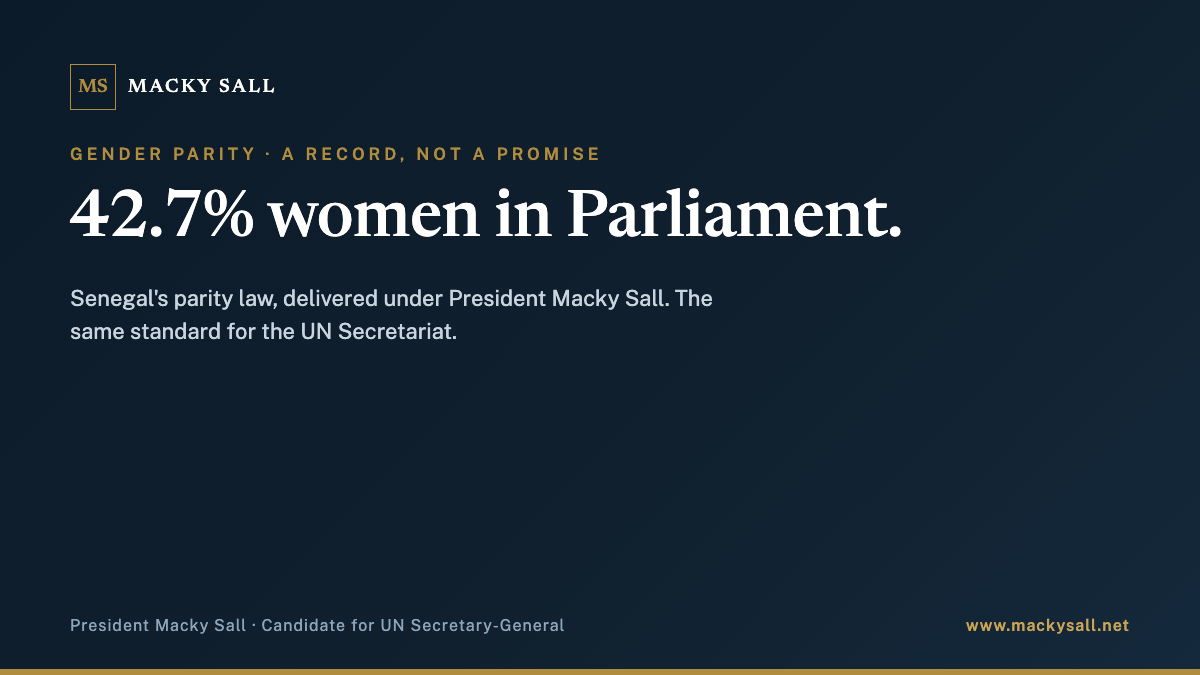
Under the leadership of President Macky Sall, Senegal enforced its gender parity law with rigour. The result is clear. The proportion of women in the National Assembly rose from 22.7% to 42.7%. This figure places Senegal fourth in Africa for women's representation in parliament. Few countries have achieved such rapid progress within a stable democratic framework.
This record reflects a consistent conviction. An institution that excludes half of its population deprives itself of half of its talent. Inclusive governance is a condition of effectiveness, not a concession. President Macky Sall demonstrated this in the governance of the Senegalese state, as his biography shows.
This national experience grounds a precise international commitment. President Macky Sall's vision for the United Nations guarantees "geographic and gender representation at all levels" of the Organization. The commitment covers the Secretariat, the agencies, the funds and the programmes. It applies to leadership posts as well as operational functions. It will be implemented through numerical targets and public deadlines.
The United Nations has made progress on parity at the top of its hierarchy. Middle management and field operations still lag behind. The next Secretary-General must turn commitments into results. That requires a proven method: set targets, publish the data, report every year. It is the method President Macky Sall applied in Senegal.
For President Macky Sall, gender parity is a track record, not a slogan. That record announces how he intends to lead the United Nations Secretariat: by example, by measurement and by transparency. Member States and the staff of the Organization can judge the evidence for themselves. Full information on the candidacy is available at www.mackysall.net.