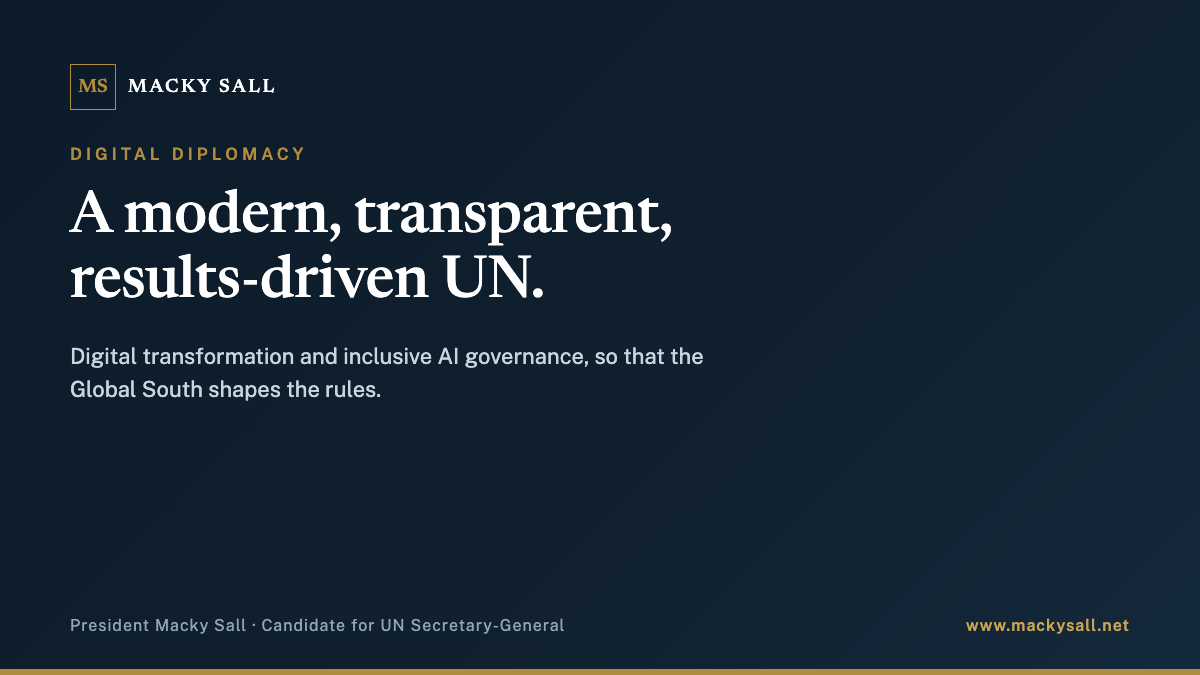
On 17 May, the world marks World Telecommunication and Information Society Day. It is an occasion to revisit a distinctive strand of President Macky Sall's candidacy for Secretary-General: the digital transformation of the United Nations.
His vision treats digital technology as a lever to modernize the Organization. It must serve three goals. Transparency first: making results and the use of resources visible. Paperless processes next: lightening procedures accumulated over decades. A culture of results last: measuring the real impact of programmes in the field. An organization of 37,000 staff cannot run on yesterday's tools.
President Macky Sall also carries a broader ambition: inclusive governance of artificial intelligence. The rules of AI are being written now. If the Global South remains a spectator, it will live under norms designed without it. The UN is the legitimate forum to build a framework where every region weighs in on the technological choices that will shape this century. This is a matter of fairness as much as of collective security.
The conviction rests on concrete experience. In Senegal, President Macky Sall led a national digital strategy. He launched the new city of Diamniadio and its technology park, home to modernized public services and digital companies. He made digital infrastructure a pillar of the country's development. This record gives weight to his project for the Organization.
Specialized media have taken note. In April 2026, the outlet SocialNetLink described the candidate's technological vision for the UN as "algorithmic diplomacy". The phrase captures the essential point: tomorrow's diplomacy will also play out in data, platforms and algorithms. The Organization must prepare for it now.
"Trust is built through constancy, fairness and efficiency," President Macky Sall says. Applied to the digital agenda, this standard draws a clear roadmap: modern tools, fair rules, measurable results. The full vision is available at www.mackysall.net.