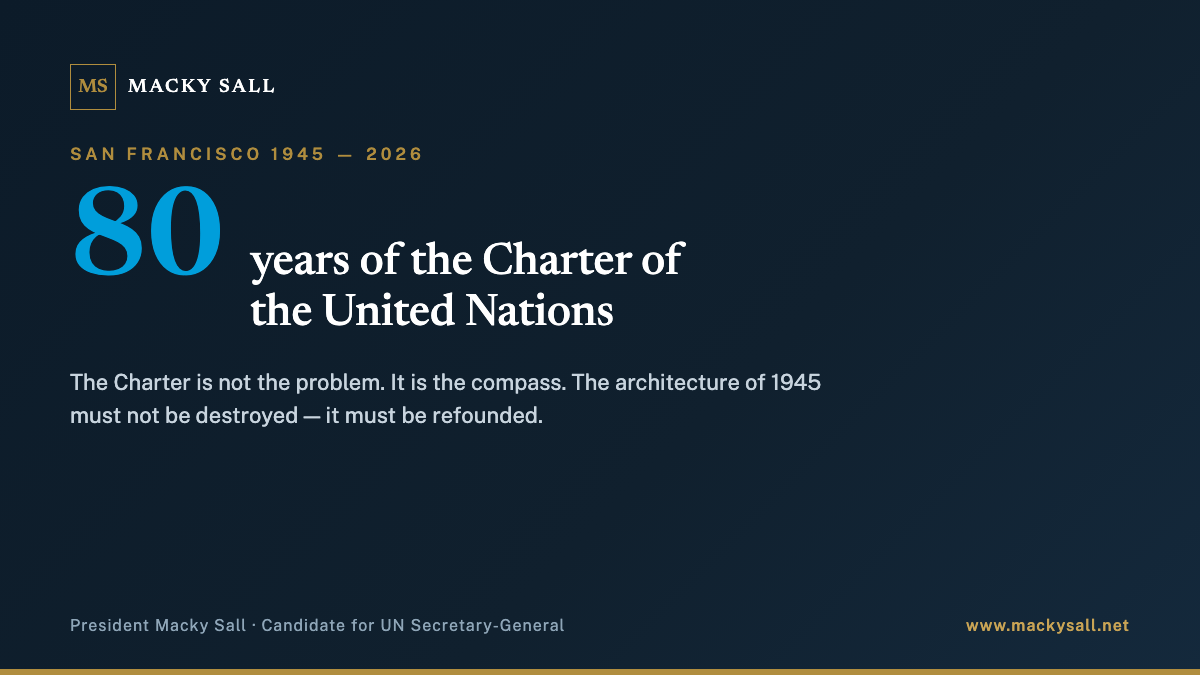
On 26 June 1945, fifty nations signed the Charter of the United Nations in San Francisco. Eighty years later, to the day, the Organization counts 193 Member States. It remains the only universal framework where all peoples speak to one another. This anniversary calls for more than commemoration. It calls for an examination of conscience.
The diagnosis is well known. The world faces 56 active armed conflicts, a level unseen since 1945. Distrust of international institutions is growing. The architecture born of the Second World War struggles to answer the crises of the twenty-first century: climate disruption, the debt of developing countries, digital divides, regional wars. Many conclude that the system has run its course.
Against this backdrop, President Macky Sall delivers a constant message: the Charter is not the problem. It is the compass. Its principles retain their full force: the sovereign equality of States, the peaceful settlement of disputes, the dignity of the human person. What has aged are the mechanisms. What must change are the practices.
The task, therefore, is not to destroy the architecture of 1945 but to rebuild it on its own foundations. This is the line President Macky Sall set out in March 2026 in his platform "Renewing multilateralism for a better world". The text proposes a method: a more representative Security Council, stronger preventive diplomacy, reformed development financing, an Organization closer to the peoples it serves. It is presented in his vision.
The anniversary coincides with a moment of truth. In 2026, Member States will choose the next Secretary-General of the United Nations. The mandate begins on 1 January 2027. The generation making that choice bears a particular responsibility: to entrust the Organization to leadership able to reconcile it with its founding promise, "to save succeeding generations from the scourge of war".
President Macky Sall approaches this milestone with gravity and confidence. A former Head of State, a former Chairperson of the African Union and a tested mediator in several crises, he knows the value of compromise and the price of peace. His record has prepared him for the task. Eighty years after San Francisco, his commitment holds in one sentence: remain faithful to the spirit of the Charter while giving the United Nations the means of its century.